
How to Fix Bad Posture with Chiropractic?

Here’s the truth: how to fix bad posture with chiropractic isn’t about willpower or conscious effort. It’s about addressing the structural changes that have already occurred in your spine and retraining your nervous system to hold proper alignment naturally.
Let’s walk through exactly how we fix bad posture and what you can expect from the process.
Why “Standing Up Straight” Isn’t Enough: The Science of Posture
Postural Distortions: Tech Neck, Anterior Pelvic Tilt, and Hyperkyphosis
Your posture isn’t just about habit – it’s structural. Years of repetitive positioning create actual changes in your spine, muscles, and connective tissue.
Common postural distortions:
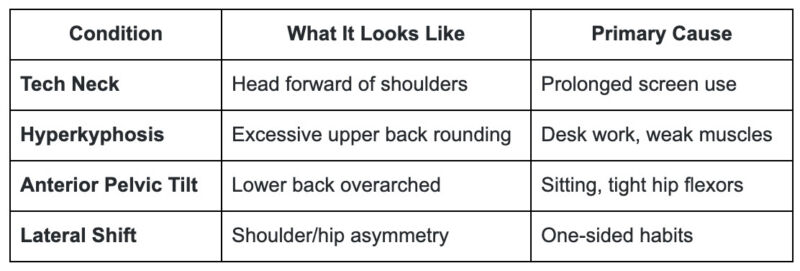
These aren’t cosmetic issues. They’re biomechanical problems that affect how your entire body functions.
The Impact of Poor Posture on Organs and Nervous System
Poor posture doesn’t just cause pain – it affects your internal health.
Systemic effects of postural dysfunction:
- Reduced lung capacity: Slouching compresses ribcage, limiting breathing
- Digestive issues: Forward posture compresses abdominal organs
- Nerve interference: Spinal misalignment disrupts brain-body communication
- Chronic fatigue: Fighting gravity wastes energy
- Hormonal changes: Altered body chemistry from chronic stress
How Corrective Chiropractic Actually “Fixes” Posture
Step 1: The Posture Audit (Digital Analysis & X-Rays)
We start with objective measurement. You can’t fix what you don’t measure.
Initial assessment includes:
- Digital posture photos from front, side, and back
- Structural X-rays showing spinal curves and alignment
- Computerized analysis comparing your spine to ideal
- Range of motion testing identifying restrictions
- Functional movement screening revealing compensation patterns
This creates your baseline – the starting point we’ll track against as we make corrections.
Step 2: Realigning the Foundation (Spinal Adjustments)
Adjustments aren’t just “cracking” your back. They’re precise corrections applied to specific segments that have lost proper position.
Our approach:
- Target misaligned vertebrae identified on X-ray
- Use gentle, specific force in exact direction needed
- Create incremental changes over multiple visits
- Allow body to adapt between adjustments
Think of it like straightening a bent tree. You can’t force it straight immediately – you apply consistent, directional pressure over time.
Step 3: Neuro-Muscular Re-education (Resetting Brain-Body Connection)
Your brain has learned your current posture as “normal.” We need to reprogram that.
Adjustments reset proprioception – your brain’s awareness of where your body is in space. Over time, proper alignment starts feeling natural instead of forced.
How this works:
- Spinal adjustments improve sensory input to brain
- Brain updates internal body map
- Muscle activation patterns change
- New posture becomes unconscious default
Step 4: Structural Rehabilitation (Corrective Exercises & Traction)
Adjustments create change. Exercises and traction make it permanent.
Corrective tools we use:
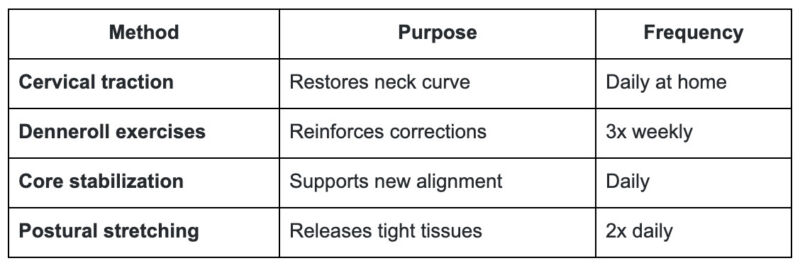
These aren’t generic exercises. They’re specific protocols designed to reinforce the structural changes we’re creating.
Relief Care vs. Corrective Care: What’s the Difference?
Most people think all chiropractic is the same. It’s not.
Relief care:
- Focuses on symptom reduction
- Visit when pain occurs
- No structural goals
- Temporary improvement
Corrective care:
- Focuses on structural changes
- Scheduled protocol regardless of pain
- Measurable alignment goals
- Permanent improvement
Learning how to fix bad posture with chiropractic requires committing to corrective care, not just relief visits.
Typical corrective timeline:
- Intensive phase (weeks 1-8): 2-3 visits weekly, aggressive correction
- Reconstructive phase (weeks 9-16): 1-2 visits weekly, stabilizing changes
- Maintenance phase (ongoing): Monthly visits, preserving corrections
Results require consistency. Missing appointments delays progress significantly.
What to Expect: The Timeline of Posture Correction
Month 1-2: Initial Changes
- Muscle soreness as body adapts
- Temporary discomfort during corrections
- Early symptom improvements
- Visible posture changes in photos
Month 3-4: Stabilization
- New alignment feeling more natural
- Reduced conscious effort to maintain posture
- Significant pain reduction
- Measurable curve improvements on X-ray
Month 5-6: Integration
- Proper posture becomes default
- Major structural corrections visible
- Functional improvements in daily activities
- Transition to maintenance schedule
Individual results vary based on:
- Severity of initial distortion
- Age and tissue health
- Compliance with home exercises
- Consistency with visit schedule
Conclusion: Take Control of Your Spinal Health
Understanding how to fix bad posture with chiropractic gives you a roadmap to permanent improvement. This isn’t about willpower or reminder apps – it’s about addressing structural changes and retraining your nervous system.
At Whole Body Wellness, we specialize in corrective chiropractic care. We don’t just treat symptoms – we create measurable structural changes that improve how your body functions for life.
Ready to fix your posture permanently instead of constantly fighting it? Schedule a comprehensive posture consultation today. We’ll perform a digital posture analysis, review structural X-rays, and create a personalized correction plan with clear goals and timelines.
See more: Can a Chiropractor Help With Posture?

Whole Body Wellness – Riverside Chiropractor
Share this blog:
$49 New Patient Special…
$49 New Patient Special…
1st Visit:
- Initial Consultation
- Chiropractic & Orthopedic Exam
- Digital Nerve, Muscle, & Heart Rate Scans
- Digital Posture Assessment
- Digital X-Rays (if necessary)
2nd Visit:
- Report of Findings with the Doctor
Offer available for new patients only. Website special must be mentioned at time of appointment. Adjustment not included.
or Call
$27 Chiro Exam
Please fill out the form below to schedule an appointment. X-Rays not included.