
What Is The Webster Technique?

When you’re expecting, every choice you make matters. You want safe, effective care that supports both you and your growing baby. If you’ve heard about what is the Webster technique from your midwife or in your online mom groups, you’re probably curious and maybe a little skeptical.
Today, we’re breaking down exactly what this specialized approach is all about and why it’s become essential for pregnancy chiropractic care.
Understanding The Webster Technique
So, what is the Webster technique? Simply put, it’s a specialized chiropractic method designed specifically for pregnant women. Think of it as a gentle tune-up for your pelvis that helps create the best possible environment for your baby.
Dr. Larry Webster developed this technique in 1978 after discovering something remarkable: when a mother’s pelvis is balanced, babies naturally move into better positions for birth. He founded the International Chiropractic Pediatric Association (ICPA) to teach this method to chiropractors worldwide.
Today, the Webster method pregnancy approach is considered the gold standard in prenatal chiropractic. It requires specialized certification – we can’t just learn it in regular chiropractic school. We need dedicated training through the ICPA to offer this care safely and effectively.
The Science Behind Pelvic Balance During Pregnancy
Here’s what happens during pregnancy: your body releases hormones that loosen your ligaments to prepare for birth. While this is natural, it can throw your pelvis out of alignment.
When your pelvis isn’t balanced, it can create what we call “intrauterine constraint” – basically, your uterus doesn’t have its ideal shape. This affects how much room your baby has to move and settle into the best position for delivery.
The Webster technique addresses this by focusing on your sacrum (the triangular bone at the base of your spine) and the ligaments supporting your uterus. When everything is aligned, your baby has optimal space to get into position naturally.
What The Webster Technique Is NOT: Debunking Common Myths
Myth #1: It’s a “breech-turning” technique
Reality: We don’t manually turn your baby. Instead, we optimize your pelvic function so your baby can move on their own.
Myth #2: The chiropractor manipulates the baby
Nope. We never touch your baby directly. All adjustments are to your pelvis and spine.
Myth #3: It only works for breech babies
Actually, the Webster technique benefits all pregnant women – whether your baby is breech or not. It’s about creating balance and comfort throughout pregnancy.
Myth #4: It’s the same as regular chiropractic adjustments
Not even close. This requires 200+ hours of specialized training beyond regular chiropractic education.
Myth #5: It’s risky or experimental
The truth? This technique has been used safely for over 45 years with no reported adverse effects on mothers or babies.
How Does The Webster Technique Work?
The Anatomical Focus: What Areas Are Treated?
During a Webster technique session, we focus on four key areas:
- Sacrum and sacroiliac joints (where your pelvis connects to your spine)
- Pelvic muscles including the psoas, piriformis, and gluteals
- Round ligaments that support your uterus
- Lumbar spine to maintain proper alignment
The Webster Technique Protocol: Step-by-Step Process
Wondering what actually happens during a session? Here’s our typical approach:
- Initial assessment – We analyze your pelvic alignment and check for imbalances
- Gentle sacral adjustment – A specific, light adjustment to restore balance
- Round ligament release – Gentle work to ease tension in the ligaments supporting your uterus
- Soft tissue work – Light massage to relax tight muscles
- Reassessment – We check your alignment to ensure everything feels right
Most sessions take 15-30 minutes. You’ll lie comfortably on a special pregnancy table with belly support – no lying flat on your stomach required.
Why Pelvic Alignment Matters for Baby Positioning
Think of your uterus like a perfectly shaped balloon. When your pelvis is balanced, that balloon maintains its ideal shape. Your baby naturally gravitates toward the position that feels most comfortable – which is usually head-down.
But when your pelvis is misaligned, it’s like squeezing one side of that balloon. Your baby might settle into a breech or posterior position simply because that’s where they fit best in the available space.
Research published in the Journal of Manipulative and Physiological Therapeutics by Pistolese shows this connection clearly. When we restore pelvic balance, we create the optimal environment for proper fetal positioning.
Webster Technique vs. Other Approaches
Webster Technique vs. Regular Chiropractic Care
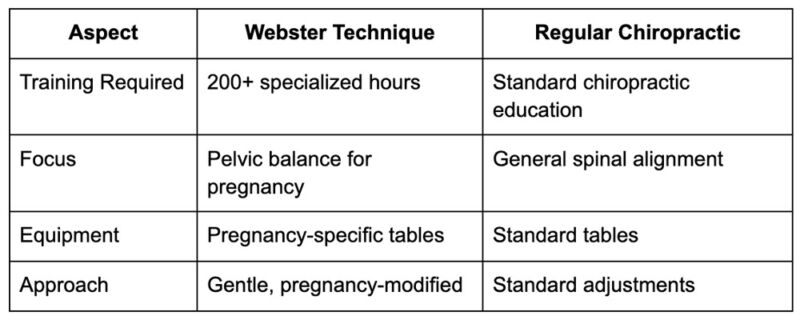
Webster Technique vs. External Cephalic Version (ECV)
If your baby is breech, your OB might mention ECV – a medical procedure where they manually try to turn the baby from outside. Here’s how they compare:
- Approach: Webster is non-invasive; ECV is a medical procedure with hands-on manipulation
- Timing: Webster can start anytime; ECV typically happens after 37 weeks
- Risk: Webster has no reported complications; ECV carries small risks including emergency C-section
- Success rates: Webster shows 82% success in ICPA studies; ECV success varies widely
Neither approach is “better” – they’re simply different options. Many women try Webster first, then consider ECV if needed.
Complementary Approaches
The Webster technique works beautifully alongside other methods:
- Spinning Babies positioning exercises
- Prenatal yoga and stretching
- Acupuncture with moxibustion
- Regular prenatal care with your OB or midwife
We actually encourage combining approaches. As your chiropractor Riverside trusts, we believe in a team approach to pregnancy care.
See more: Pregnancy Chiropractic Care: Your All-in-One Guide to a Healthier, Easier Pregnancy
Benefits Of The Webster Technique During Pregnancy
Primary Benefits: Optimal Fetal Positioning
According to ICPA research, the Webster technique shows an impressive 82% success rate for helping breech babies move to head-down position. That’s significant when you consider it’s completely non-invasive.
Even if your baby isn’t breech, regular Webster care throughout pregnancy can prevent malposition from developing in the first place. Prevention is always easier than correction.
Secondary Benefits: Pregnancy Comfort & Wellness
Beyond baby positioning, our patients consistently report relief from:
- Lower back and sacroiliac joint pain
- Sciatica shooting down the legs
- Round ligament pain (those sharp pains when you move suddenly)
- Pelvic girdle pain and instability
- Pubic symphysis dysfunction
Many women also sleep better and maintain better posture as their belly grows.
Labor & Delivery Outcomes
Here’s where things get really interesting. Research by Fallon and colleagues in the Journal of Manipulative and Physiological Therapeutics found that women receiving chiropractic care during pregnancy experienced:
- Shorter labor times overall
- Less need for pain medication
- Reduced medical interventions during delivery
- Lower rates of C-section due to malposition
We can’t guarantee these outcomes for everyone, but the research is encouraging.
Who Can Benefit From The Webster Technique?
Ideal Candidates
We see amazing results with:
- All pregnant women seeking preventive care
- Women with breech, transverse, or posterior babies
- Those experiencing pelvic pain or discomfort
- Anyone with a history of difficult labor or C-section
- Moms expecting twins or multiples
- Athletes staying active during pregnancy
- Women with pre-existing spinal conditions
Specific Conditions That Respond Well
The Webster technique is particularly helpful for:
- All types of breech presentation (frank, complete, footling)
- Posterior baby position
- Pelvic girdle pain (PGP)
- Sacroiliac joint dysfunction
- Symphysis pubis dysfunction (SPD)
- Pregnancy-related sciatica
How To Find A Qualified Webster-Certified Chiropractor
Certification Requirements & What They Mean
ICPA Webster Certification requires extensive additional training beyond chiropractic school. We complete hands-on courses, pass rigorous exams, and maintain ongoing education.
When choosing a provider, always verify they’re ICPA-certified. This ensures they’ve met the highest standards for pregnancy chiropractic care.
Questions To Ask When Choosing a Provider
Before booking, ask potential providers:
- “Are you Webster Certified through ICPA?”
- “How many pregnant patients do you see weekly?”
- “What’s your experience with breech presentations?”
- “Do you have pregnancy-specific tables and equipment?”
- “Do you work collaboratively with OBs and midwives?”
These questions help you find someone with real experience, not just a certificate on the wall.
Getting Started with Webster Technique Care
Ready to experience the benefits of the Webster technique? Here’s how to get started.
- When to schedule: Ideally, begin care in your second trimester. But remember – it’s never too early or too late to start.
- What to bring: Just yourself and any relevant medical records. Wear comfortable clothing.
- What to expect: Your first visit includes a thorough consultation, pelvic assessment, and usually your first gentle adjustment.
At Whole Body Wellness Chiropractic, we’re here to support you through every stage of pregnancy. Whether you’re dealing with discomfort, concerned about the baby’s position, or simply want the best possible preparation for birth, we’re ready to help.
Ready to take the next step? Contact us today to schedule your consultation. Let’s work together to make your pregnancy as comfortable and healthy as possible. Your body and your baby will thank you.
Frequently Asked Questions About The Webster Technique
How many sessions will I need?
It varies. For general pregnancy wellness, we typically recommend visits every 2-4 weeks. For breech babies, we often see women weekly from 32-37 weeks.
Does the Webster technique hurt?
Not at all. Most women find it relaxing. You might feel some light pressure during the adjustment, but it shouldn’t be painful.
Can I start too late in pregnancy?
It’s never too late to start, though earlier is always better. We’ve had babies turn even at 39 weeks, though success rates are highest between 32-37 weeks for breech presentations.
Will my baby turn immediately after treatment?
Sometimes babies move during or right after a session. Other times it takes a few days or several sessions. Every baby has their own timeline.

Whole Body Wellness – Riverside Chiropractor
Share this blog:
$49 New Patient Special…
$49 New Patient Special…
1st Visit:
- Initial Consultation
- Chiropractic & Orthopedic Exam
- Digital Nerve, Muscle, & Heart Rate Scans
- Digital Posture Assessment
- Digital X-Rays (if necessary)
2nd Visit:
- Report of Findings with the Doctor
Offer available for new patients only. Website special must be mentioned at time of appointment. Adjustment not included.
or Call
$27 Chiro Exam
Please fill out the form below to schedule an appointment. X-Rays not included.