
What's the Difference Between a Headache and a Migraine?

A question we hear constantly at our practice: what's the difference between a headache and a migraine? And honestly, it's not always easy to tell. Both cause head pain. Both can disrupt your day. But they're fundamentally different conditions that require different approaches.
Today, we're clearing up the confusion once and for all.
Headache vs. Migraine: Why So Many People Get Them Confused
Let's start with the elephant in the room: both headaches and migraines involve pain in your head. That's where the similarity ends, but it's also why people mix them up constantly.
Here's the real issue: migraines are often downplayed as "just bad headaches." We hear this all the time from patients who've suffered for years, taking the wrong approach because they didn't understand what they were dealing with.
Why does correct identification matter? Simple. Headaches and migraines have different root causes, different triggers, and respond to different treatments. Taking ibuprofen for a migraine is like putting a band-aid on a broken bone – it might help temporarily, but it's not addressing the real problem.
What Is a Headache?
A headache is exactly what it sounds like: pain or discomfort in your head. But here's what most people don't realize – a headache isn't a disease. It's a symptom.
Think of it like a check engine light in your car. The light itself isn't the problem; it's telling you something underneath needs attention.
Headaches typically stem from muscle tension, joint dysfunction, nerve irritation, or changes in blood flow. The pain can be dull, sharp, constant, or intermittent. Location varies too – forehead, temples, back of the head, or all over.
Common Types of Headaches
- Tension Headaches
- Sinus Headaches
- Cluster Headaches
- Cervicogenic Headaches
What Is a Migraine?
Now we're talking about something entirely different. A migraine isn't just head pain – it's a neurological disorder affecting your brain, nerves, and blood vessels.
Dr. Richard Lipton, a leading migraine researcher at Albert Einstein College of Medicine, describes migraines as a "neurovascular disorder" involving abnormal brain activity. This triggers a cascade of changes in your nervous system and blood flow.
Translation? Your brain isn't processing information normally during a migraine. That's why migraines cause symptoms far beyond just pain.
Common Migraine Symptoms
Migraines typically involve several symptoms happening together:
- Throbbing or pulsing pain (often moderate to severe)
- One-sided head pain (though not always)
- Nausea or vomiting
- Extreme sensitivity to light, sound, and smells
- Visual disturbances like seeing spots, zigzag lines, or temporary blind spots (called aura)
- Brain fog during and after the migraine
- Post-migraine fatigue that can last for days
Some people experience warning signs hours or even a day before the pain hits—mood changes, food cravings, neck stiffness, or frequent yawning.
Common Migraine Triggers
Understanding your triggers is half the battle. Common ones include:
- Emotional stress and nervous system overload
- Hormonal fluctuations (many women notice patterns with their menstrual cycle)
- Poor sleep quality or irregular sleep schedules
- Neck tension and spinal dysfunction
- Certain foods (aged cheese, processed meats, artificial sweeteners)
- Dehydration
- Bright lights, strong odors, or loud noises
Notice something? Many of these triggers involve your nervous system. Keep that in mind – we'll circle back to it.
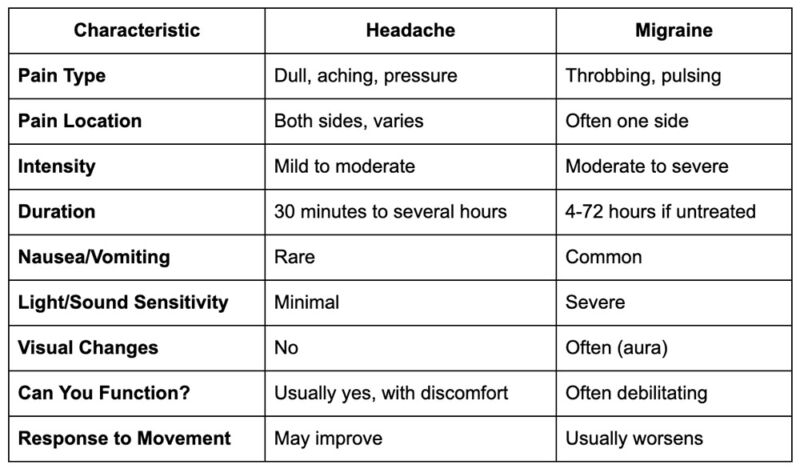
Headache vs. Migraine: Key Differences at a Glance
Let's make this crystal clear with a side-by-side comparison:
How the Neck, Spine, and Nervous System Influence Headaches and Migraines
Here's where things get interesting and where we see remarkable results as a chiropractor Riverside patients trust for headache relief.
Your neck and spine play a massive role in both headaches and migraines. Let's talk about why.
Forward Head Posture and Spinal Misalignment
For every inch your head moves forward from its ideal position, it adds 10 pounds of extra stress on your neck. Spending hours hunched over a computer? Your neck muscles are working overtime, creating tension that radiates into your head.
Cervical Joint Dysfunction and Nerve Irritation
When joints in your upper neck don't move properly, they irritate surrounding nerves. The upper cervical nerves share pathways with the trigeminal nerve – the main pain pathway for your head and face.
Result? Neck problems can:
- Trigger headaches directly
- Lower your migraine threshold (making attacks more likely)
- Increase frequency and severity of both conditions
- Prolong recovery time
Why Imaging Often Misses the Problem
Here's something that frustrates patients constantly: you get an MRI or CT scan, and it comes back "normal." But you're still suffering.
Why? Because these images show structure – bones, discs, major abnormalities. They don't show function. They can't tell us if your joints are moving properly, if muscles are balanced, or if nerves are being irritated by mechanical dysfunction.
Treatment Options for Headaches and Migraines
Conventional Medical Treatment Options
Standard medical approaches typically include:
- Over-the-counter pain relievers (ibuprofen, acetaminophen, aspirin)
- Prescription migraine medications (triptans, ergotamines)
- Preventive medications (beta-blockers, antidepressants, anti-seizure drugs)
These can be lifesaving during acute attacks. We're not anti-medication – sometimes you need immediate relief.
But here's the catch: medication manages symptoms without addressing underlying causes. Plus, overuse can lead to rebound headaches, dependency, and unwanted side effects. It's a tool, not a long-term solution.
Corrective Chiropractic Care for Headaches and Migraines
This is where we see patients' lives change. Corrective chiropractic focuses on identifying and addressing the root mechanical and neurological dysfunctions contributing to your pain.
Our approach involves:
- Comprehensive Spinal and Postural Evaluation
- Reducing Nerve Interference
- Improving Joint Mobility and Muscle Balance
- Supporting Long-Term Nervous System Regulation
Do You Have a Migraine or a Headache? A Simple Self-Check
Still not sure which one you're dealing with? Ask yourself these questions:
- Does your pain throb or pulse with your heartbeat?
- Is it primarily on one side of your head?
- Does light or sound make the pain worse?
- Do you feel nauseous or have you vomited?
- Does the pain get worse when you move around?
- Does it prevent you from doing normal activities?
- Have you noticed any visual changes before or during the pain?
If you answered yes to three or more questions, you're likely experiencing migraines, not just headaches.
Keep a pain journal for a few weeks. Track when pain hits, how long it lasts, what you were doing beforehand, and all symptoms. Patterns often emerge that point clearly toward one condition or the other.
Important note: Self-diagnosis has limits. If you're experiencing frequent or severe head pain, get professional evaluation. Some serious conditions can mimic headaches or migraines.
What to Do Next If You're Struggling With Headaches or Migraines
Understanding the difference between a headache and a migraine is your first step toward real relief. But knowledge alone won't stop the pain.
Here's what we recommend:
- Get a Proper Diagnosis
- Consider a Functional Approach
- Address Your Spine and Nervous System
We've seen too many patients suffer needlessly for years before seeking help. The longer dysfunction persists, the harder it becomes to correct.
At Whole Body Wellness Chiropractic, we specialize in helping people break free from chronic headaches and migraines. We don't just mask symptoms – we identify and correct the underlying problems causing them.
Ready to get answers? Schedule a comprehensive evaluation with our team. Let's figure out exactly what's going on and create a personalized plan to help you feel like yourself again. You don't have to live with constant head pain. Real, lasting relief is possible and we're here to help you find it.

Whole Body Wellness – Riverside Chiropractor
Share this blog:
$49 New Patient Special…
$49 New Patient Special…
1st Visit:
- Initial Consultation
- Chiropractic & Orthopedic Exam
- Digital Nerve, Muscle, & Heart Rate Scans
- Digital Posture Assessment
- Digital X-Rays (if necessary)
2nd Visit:
- Report of Findings with the Doctor
Offer available for new patients only. Website special must be mentioned at time of appointment. Adjustment not included.
or Call
$27 Chiro Exam
Please fill out the form below to schedule an appointment. X-Rays not included.